STUDY #15 · 2026 · IN OBSERVATION
Magnetic Pendulum Basins
A model-driven visual study of fractal basins of attraction.
WHAT IS THIS
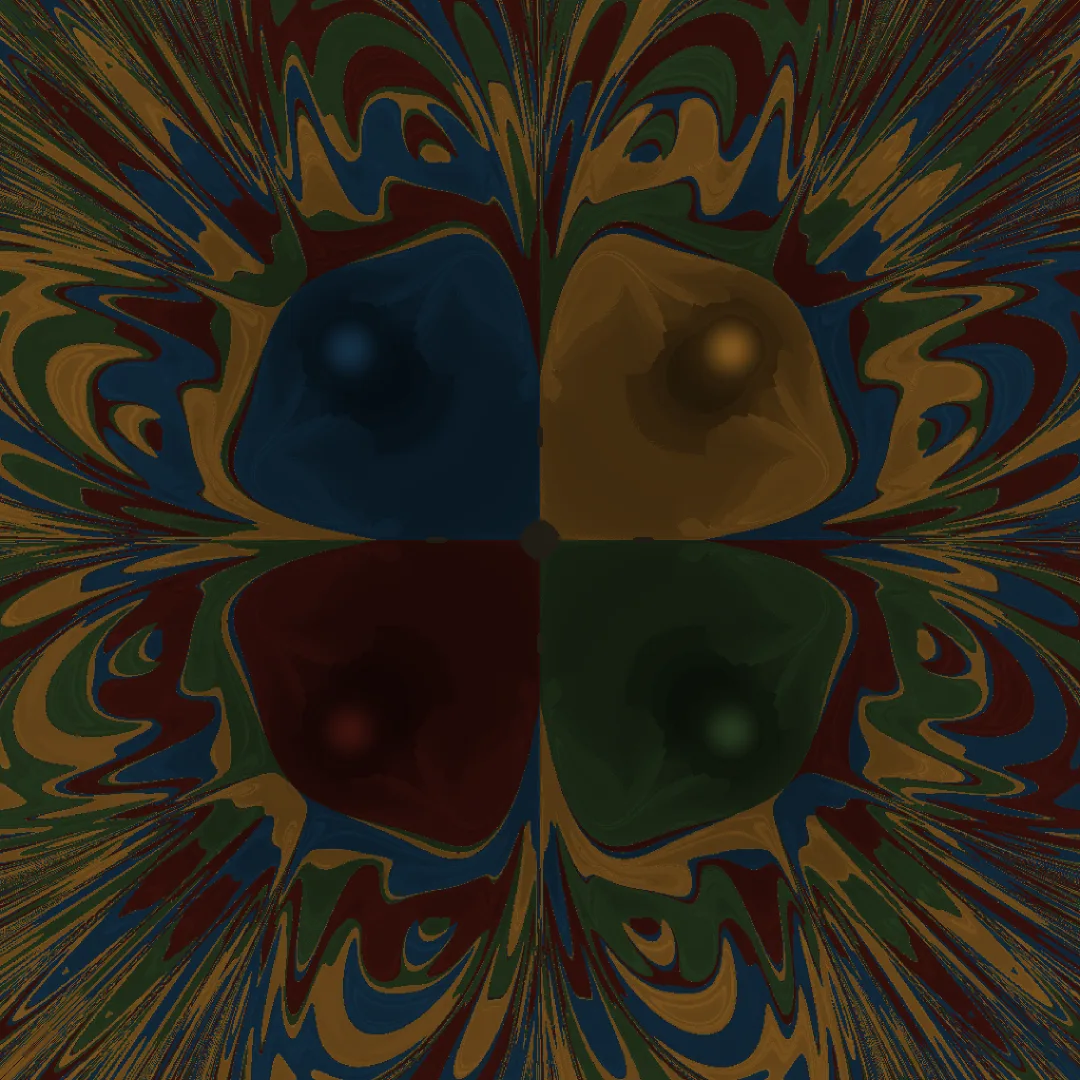
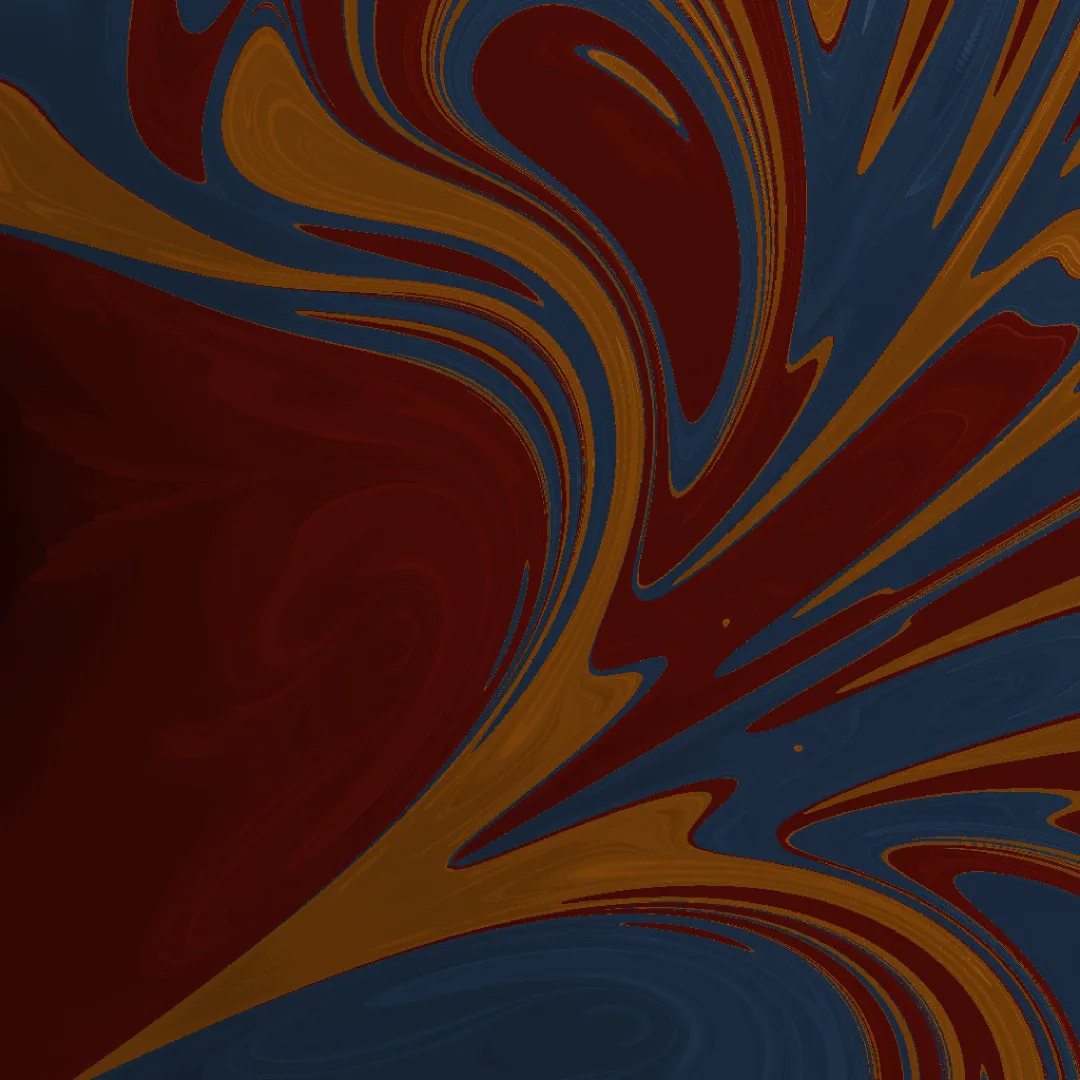
A steel pendulum swings above three magnets. Friction slowly drains its energy until it hangs over one of them — but which one is practically unpredictable: releases a hair's-width apart end on different magnets. This study colours every possible starting point by its final magnet, turning the plane into an atlas of fate whose three territories interlock along a fractal boundary (a "Wada" boundary: every point of it touches all three).
The model is the standard planar magnetic pendulum — friction, a restoring pull toward the centre, and three regularised magnetic wells. This study integrates one pendulum per pixel on the GPU (about a million at once) and runs in real time, so the map visibly resolves out of the undecided shimmer.
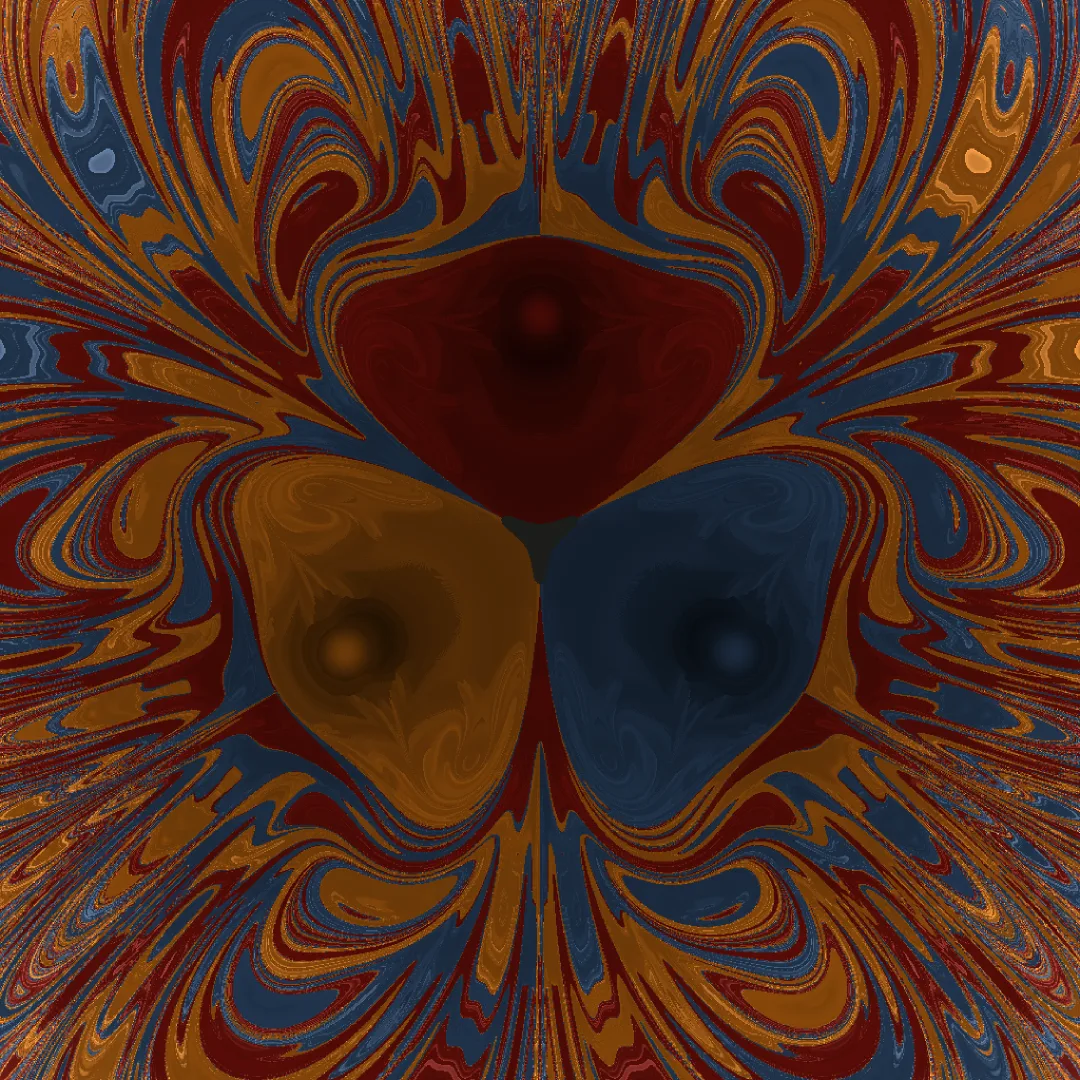
This is not a scientific simulation result, but a visual interpretation of the phenomenon.
THE SAME FAMILY, A DIFFERENT QUESTION
Lorenz follows one orbit. This study asks all of them at once.
PARAMETERS EXPLORED
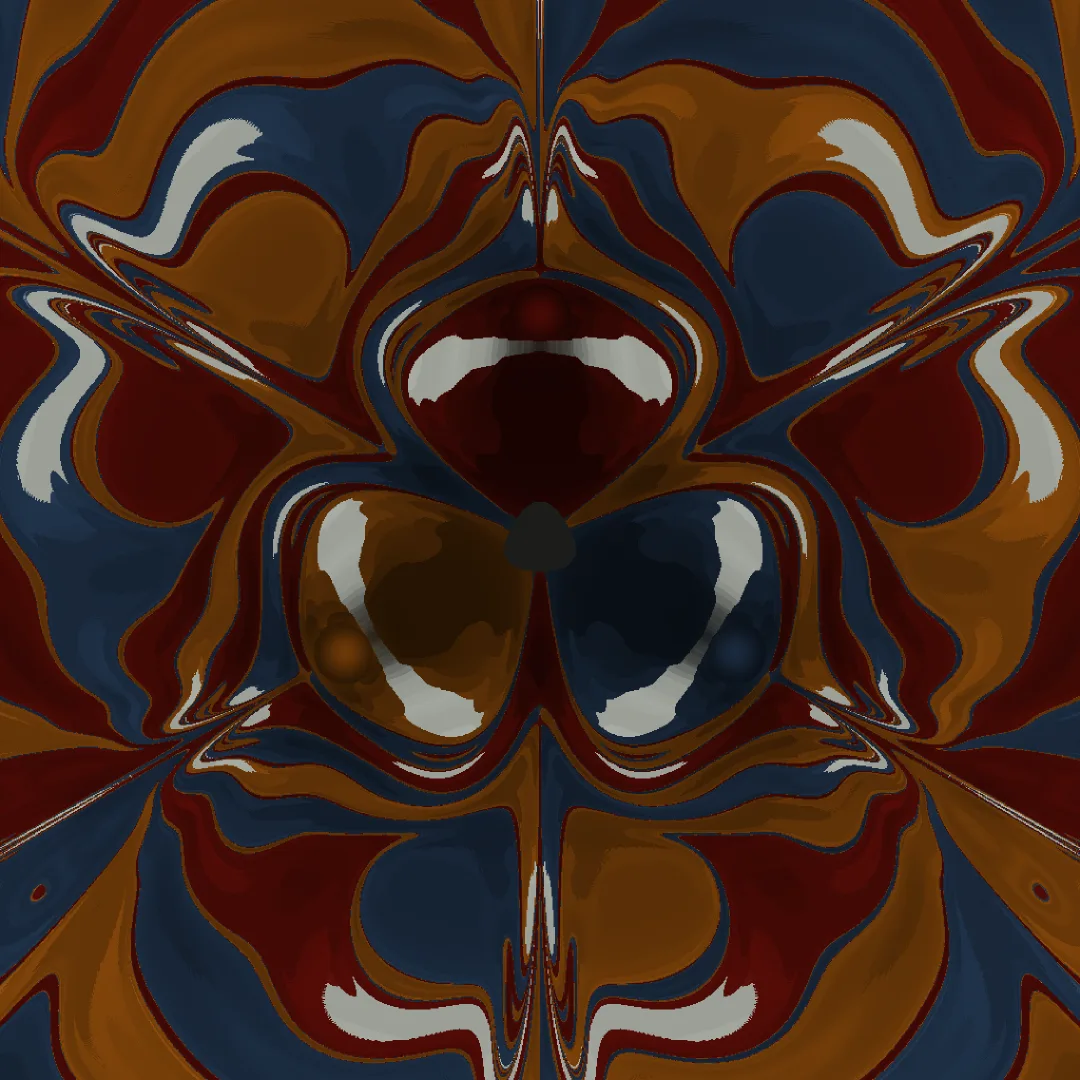
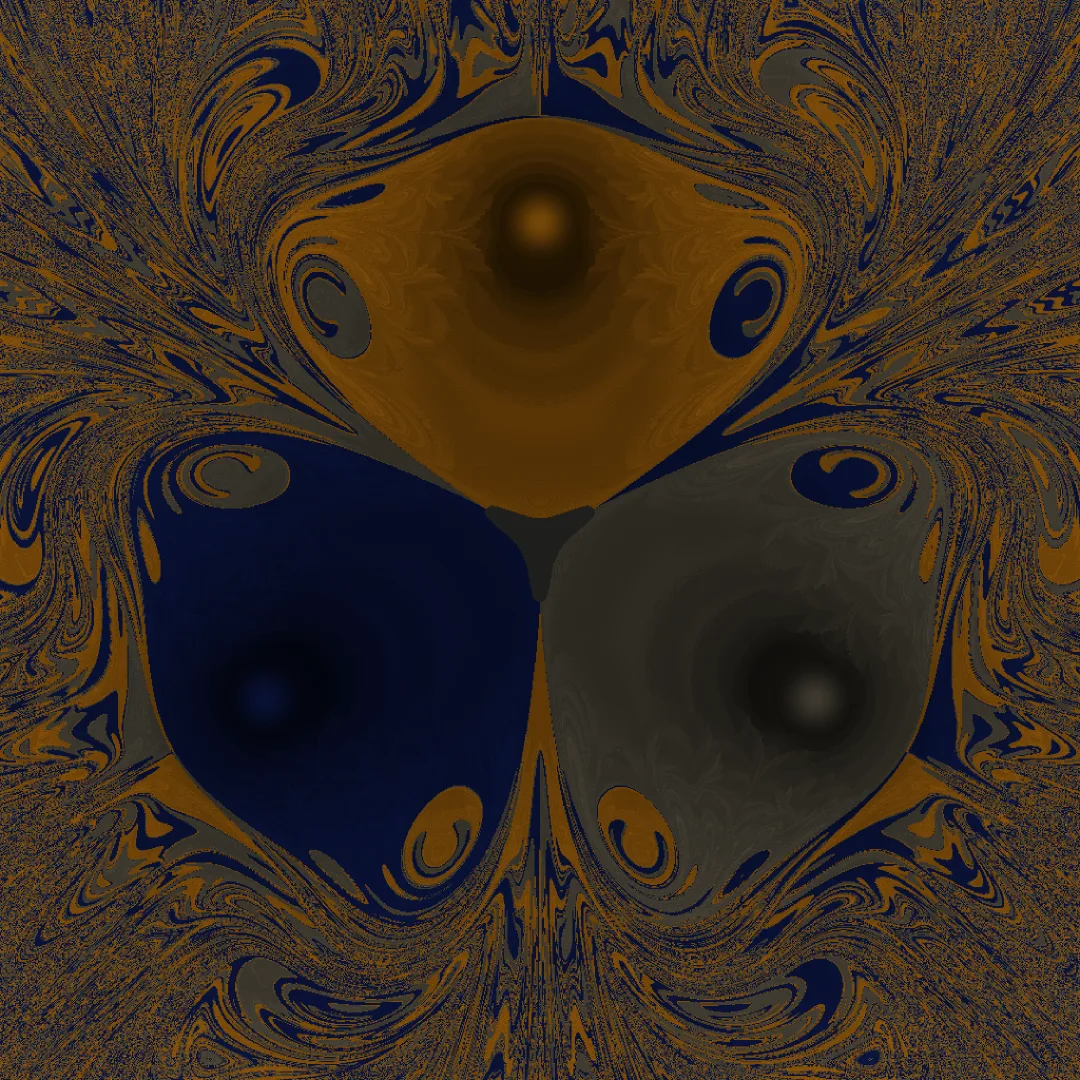
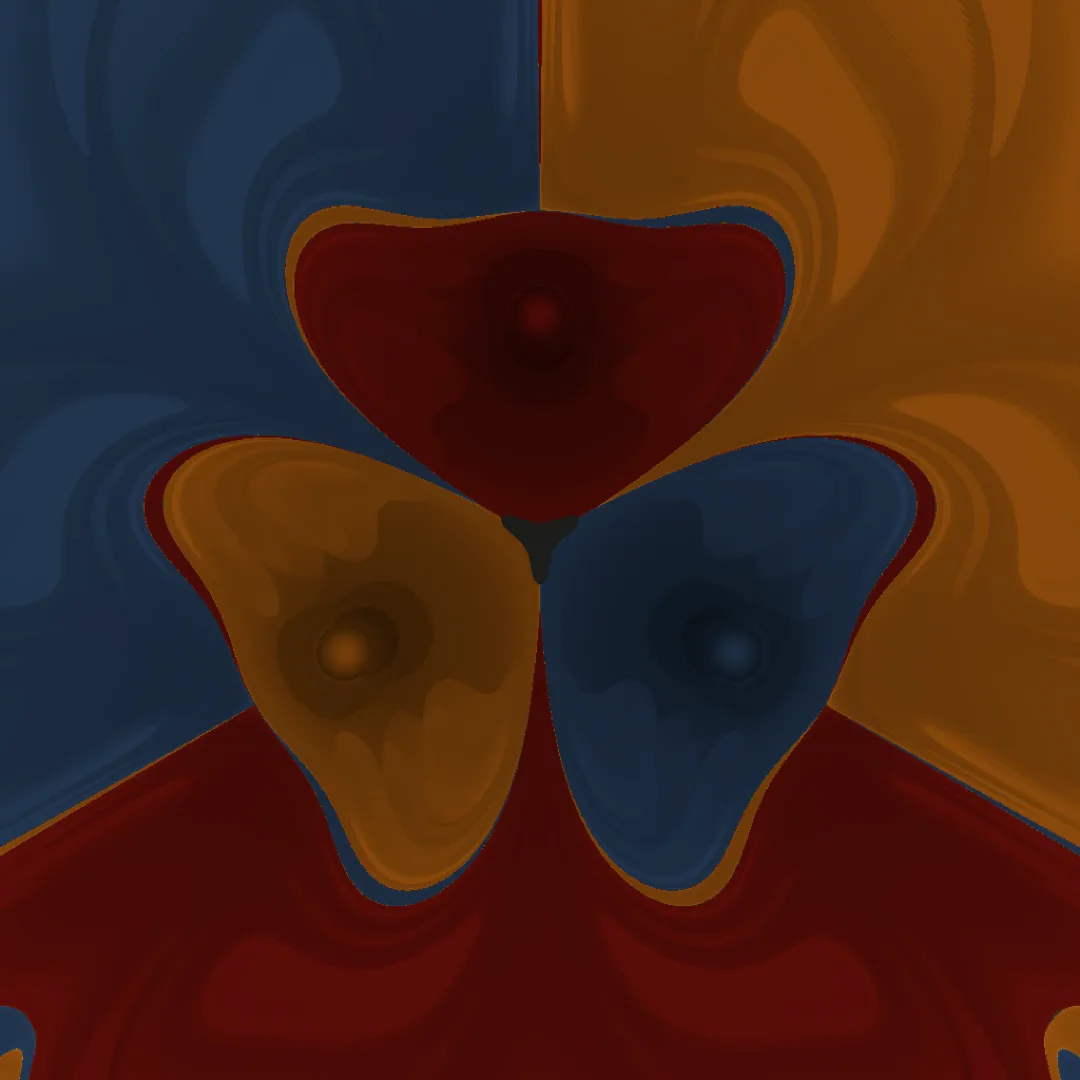
Each image below records its exact parameter set.
SELECTED STILLS — 6
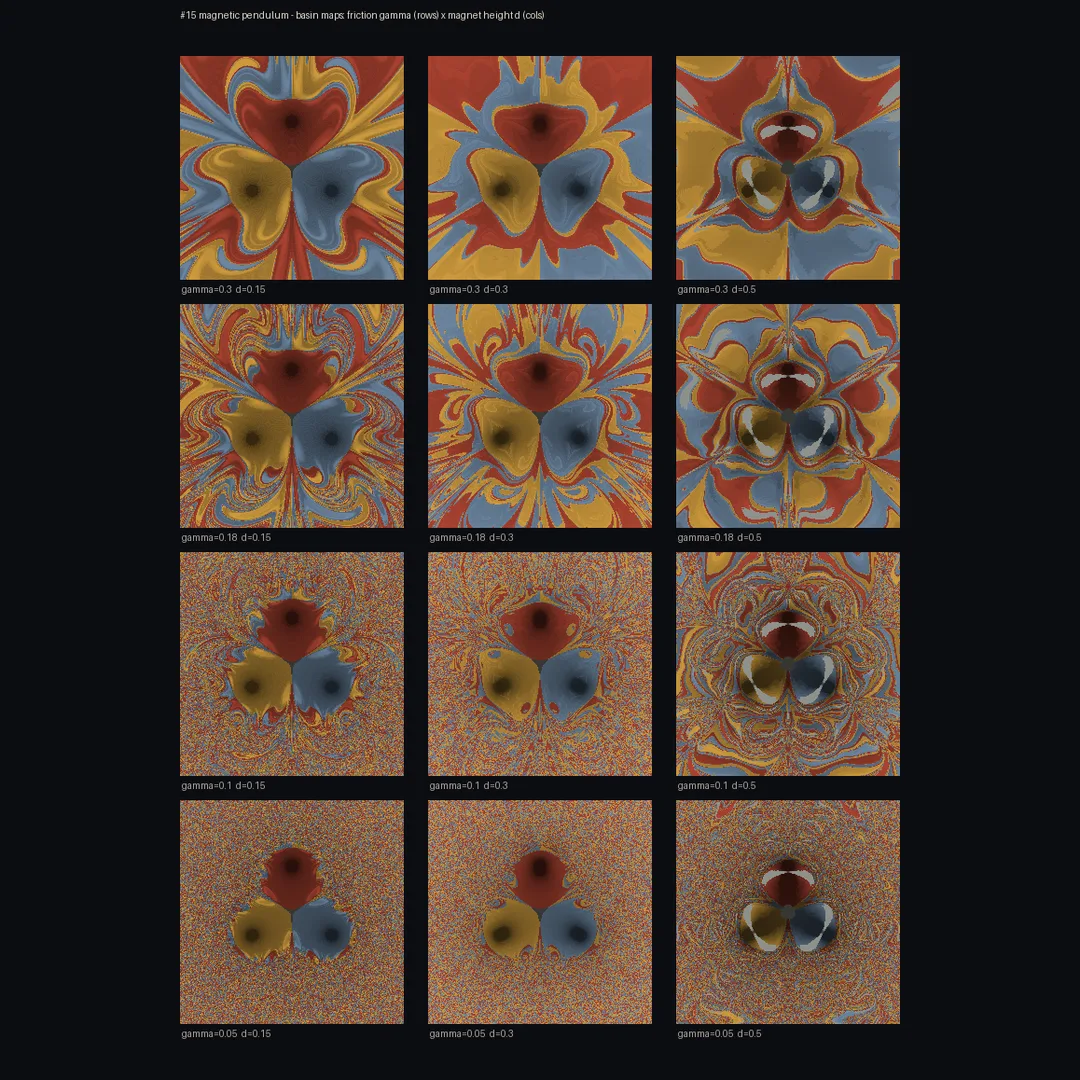
PROCESS — PARAMETER SWEEPS
Friction γ against magnet height d — the phase map of fate. Down the friction axis the boundary shatters from smooth pie to all-invading filigree; along the height axis the fourth, magnet-less fate is born.
SIGNATURE — WHERE FATE CANNOT BE TOLD, IT SHINES
The boundary is measured, not just admired.
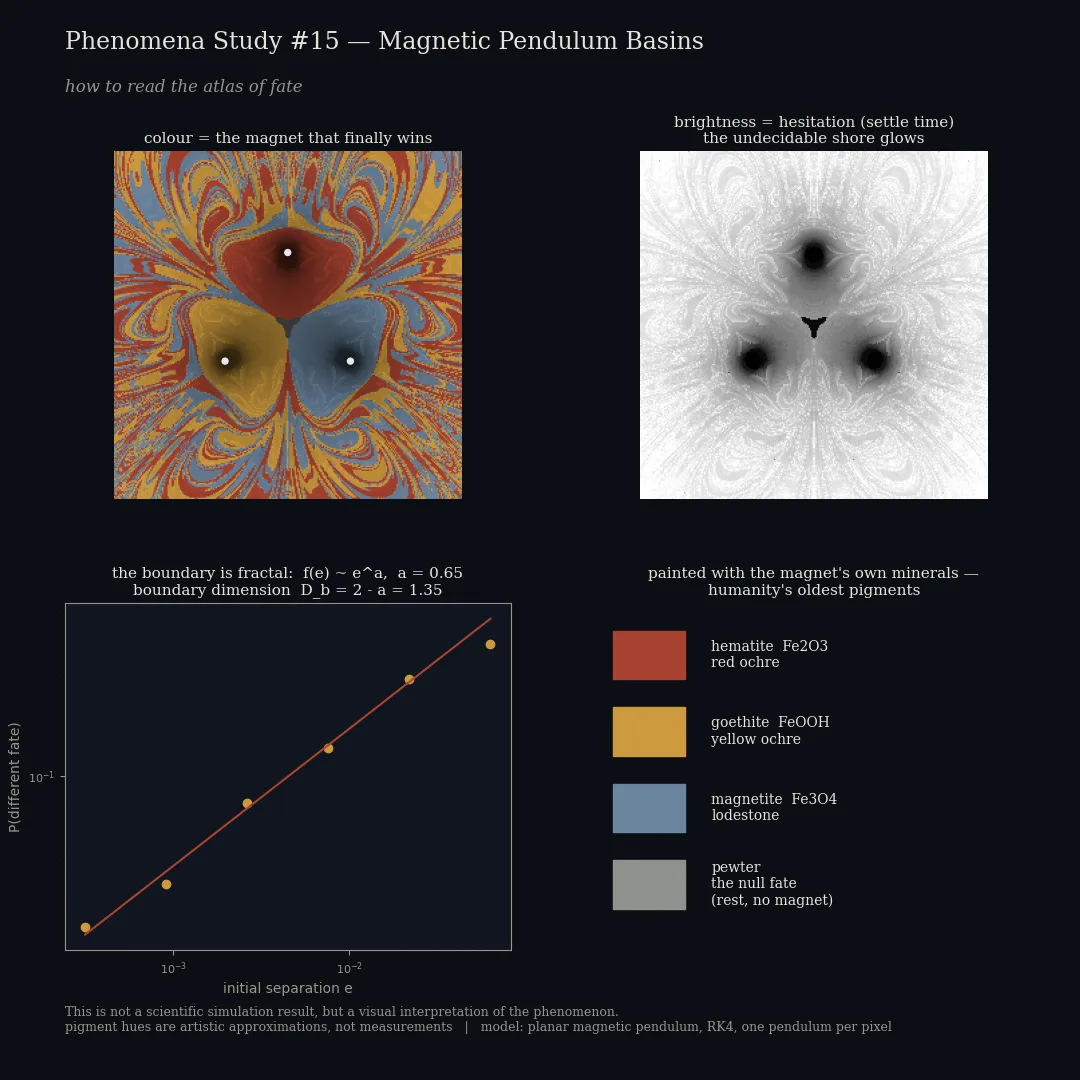
Brightness in these maps is hesitation: each point glows by how long its pendulum wavered before settling. The fractal boundary — where releases a hair's-width apart end on different magnets — is therefore the part that shines. The map's darkness is certainty; its light is doubt.
And the doubt is quantified: the uncertainty exponent of McDonald-Grebogi-Ott-Yorke, measured inside this model as α ≈ 0.62, gives the boundary dimension D_b ≈ 1.38 at the hero's friction — final-state sensitivity made visible, then measured.
COLOUR = IRON OXIDES
The three basins are painted with the three iron-oxide pigments — hematite red (Fe₂O₃), goethite ochre (FeOOH), magnetite blue-black (Fe₃O₄). This is the magnet's own mineral chemistry: magnetite is lodestone, the first magnet humanity ever knew — and these same oxides were the first pigments humanity ever painted with. A map of magnetism, painted in magnetite's family colours.
Brightness maps settle time — hesitation glows — and the pewter regions are a real fourth fate: equilibria where the bob stops away from every magnet.
Pigment hues are artistic approximations of the minerals, not measurements.
REFERENCES
- S. W. McDonald, C. Grebogi, E. Ott, J. A. Yorke. "Fractal basin boundaries." Physica D, vol.17, 125-153 (1985).
- A. E. Motter, M. Gruiz, G. Károlyi, T. Tél. "Doubly Transient Chaos: Generic Form of Chaos in Autonomous Dissipative Systems." Physical Review Letters, vol.111, 194101 (2013).
INTERACTIVE STUDY
The map is not drawn — it develops. Every pixel is one pendulum released from rest at that point and integrated until it falls to a magnet, so the atlas resolves row by row like a print in the tray. Colour is the winning magnet, brightness is hesitation, and the wax-pale pixels are the null fate — rest away from every magnet. Nudge the knobs, then press REDEVELOP to expose a fresh map. It is a deliberately simplified instrument — a smaller map with capped iterations — separate from the full engine used to author the finished works.
This interactive study is not intended as a scientifically validated reproduction. It is a visual interpretation generated from an implemented model and curated parameter exploration — and it is a deliberately simplified instrument, separate from the full engine used to author the finished works.