STUDY #11 · 2026 · IN OBSERVATION
BZ III — Scroll Waves
A model-driven visual study of the invisible threads that organise three-dimensional chemical waves.
WHAT IS THIS
In a shallow dish, the Belousov–Zhabotinsky reaction draws spirals that turn around a point. Give the medium depth, and that point stretches into a line: a filament, around which the whole three-dimensional wave — a scroll wave — rotates. The filament is invisible: it is not a substance but a phase singularity, and it behaves like a physical thread, with tension. A closed filament ring contracts and vanishes; in other regimes threads stretch and multiply into tangles.
This study extends the study #01 Oregonator engine to three dimensions and runs it in real time on the GPU. The filament is extracted each frame by a topological detector and rendered as a glowing thread inside the translucent wave volume.
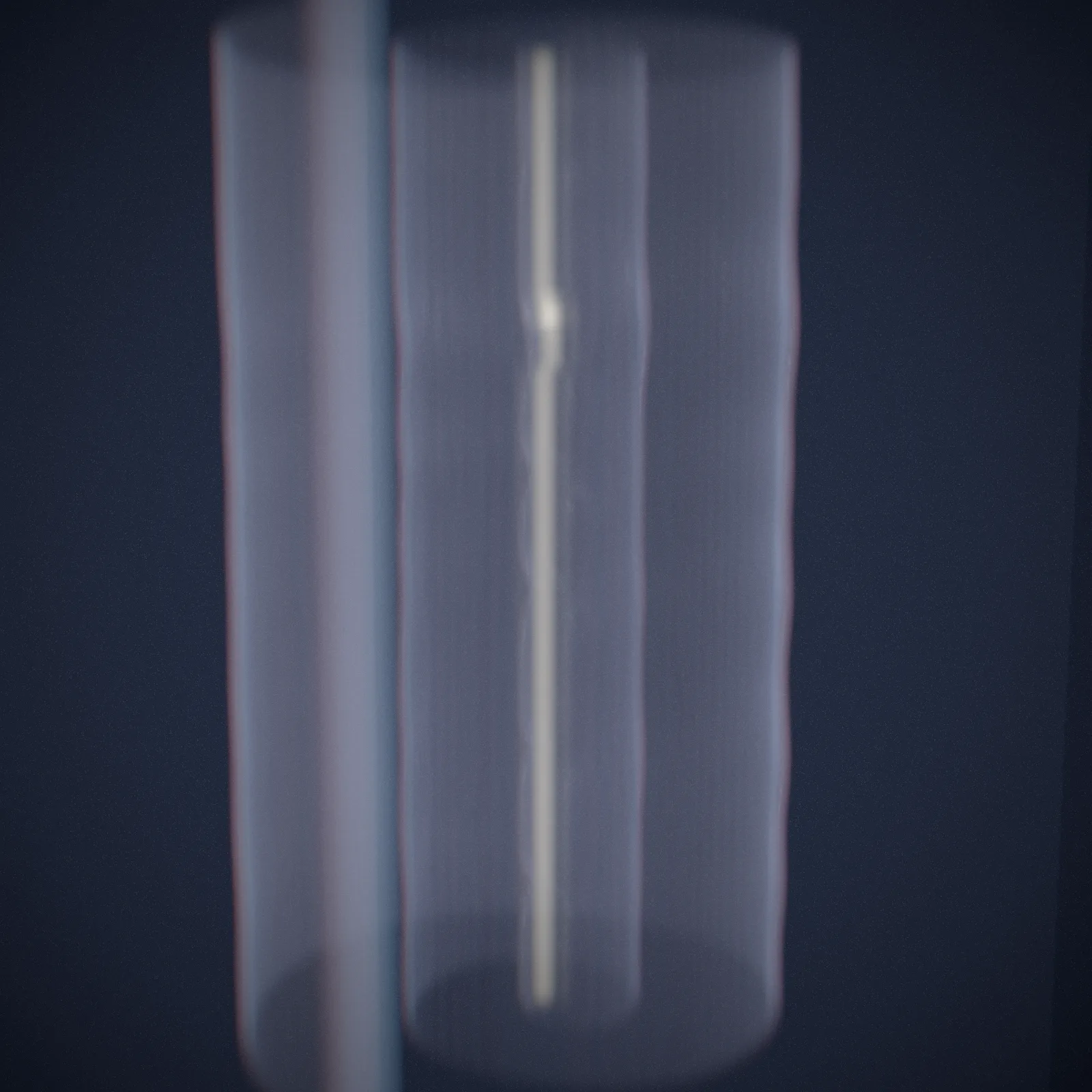
This is not a scientific simulation result, but a visual interpretation of the phenomenon.
FROM A POINT TO A LINE
The spiral's heart, given depth.
PARAMETERS EXPLORED
Each image below records its exact parameter set.
SELECTED STILLS — 4
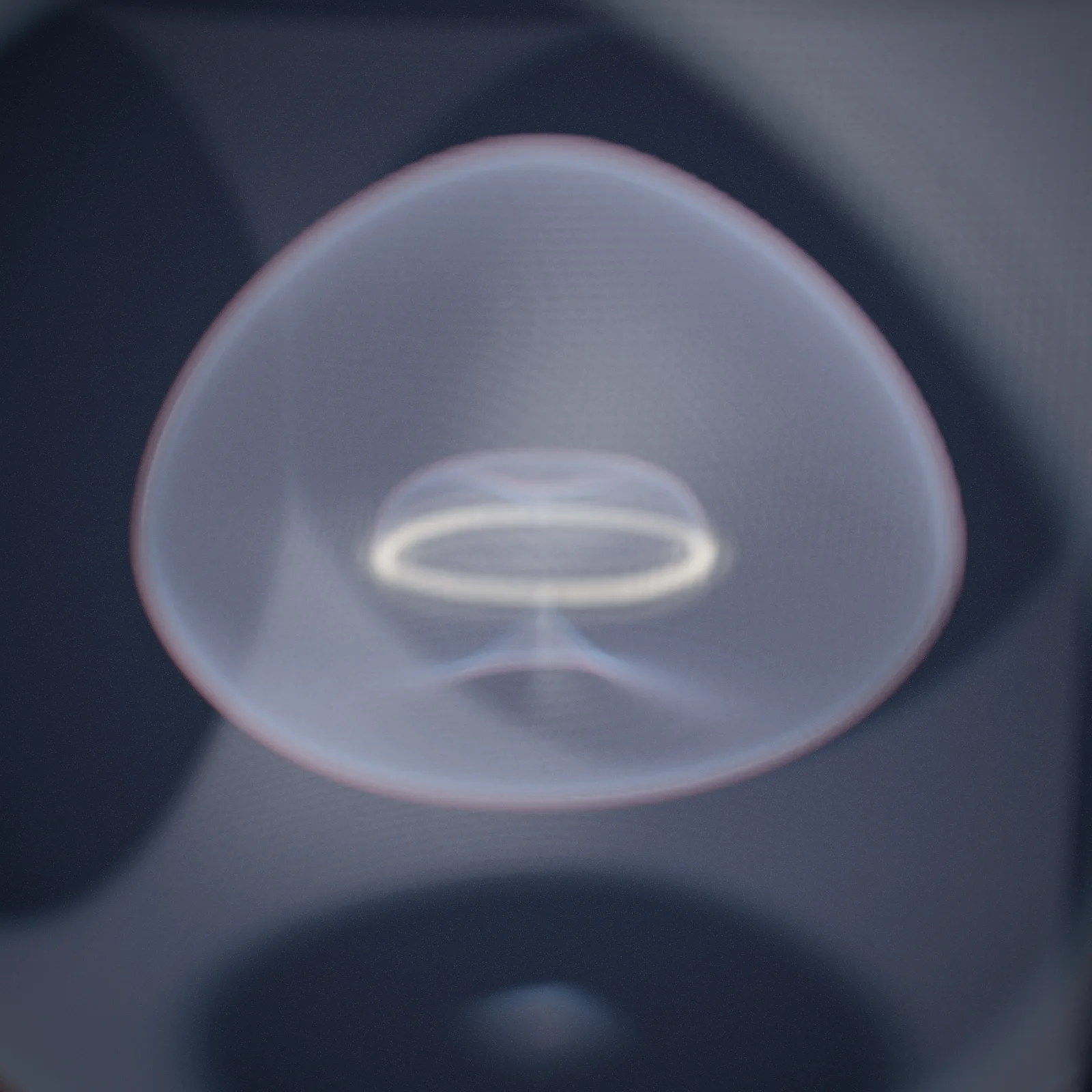
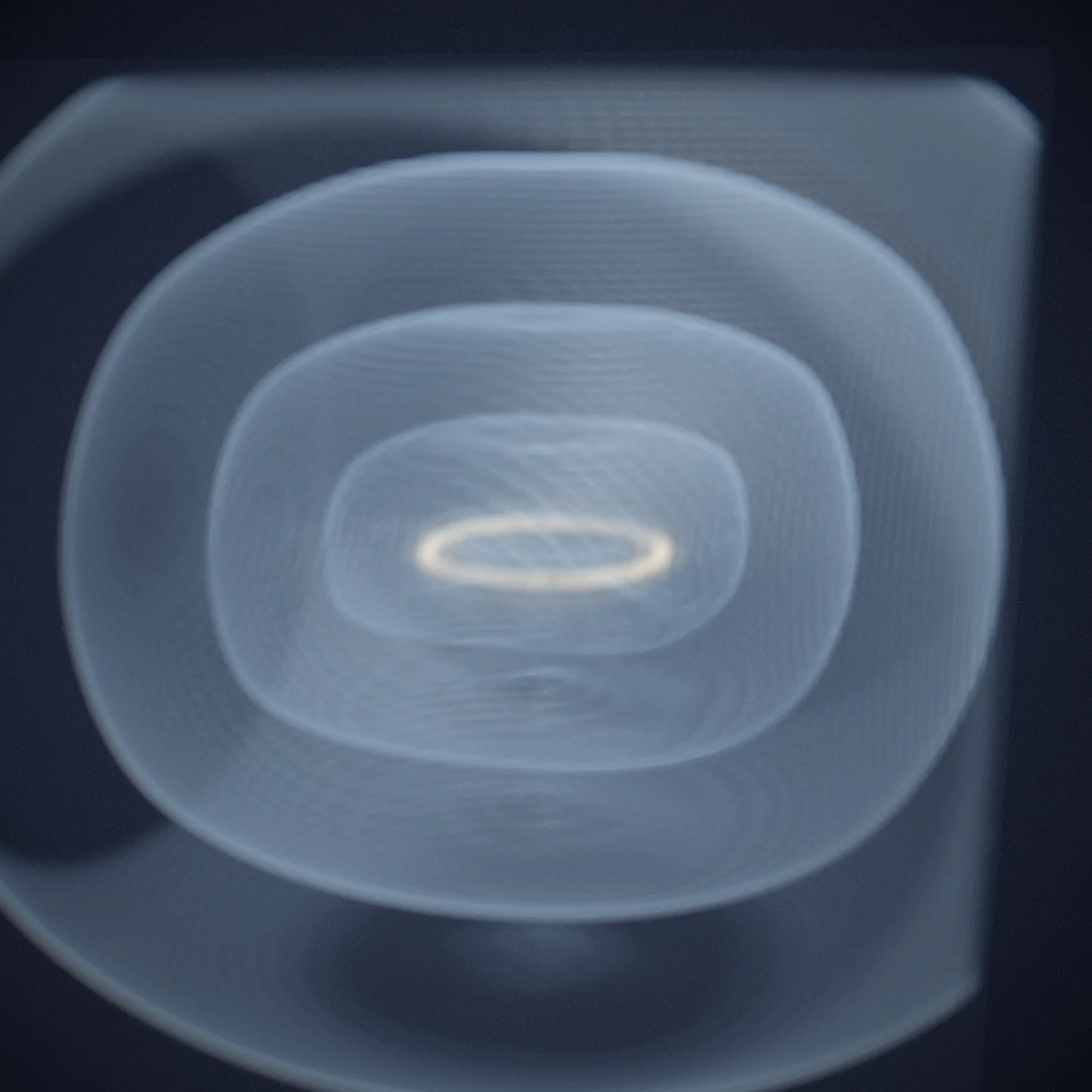
SIGNATURE — THE THREAD THAT HOLDS ITSELF
A ring that should vanish, held up by its own waves.
A closed filament ring contracts under its own line tension — inside this model, its area R² falls linearly in time, and the tension flips sign as excitability weakens. Left alone, the ring should shrink to nothing.
But in this confined volume the waves the ring itself sheds reflect and push back, and the thread settles into a breathing equilibrium — nested tori engraved around a ring that refuses to die. The hero film is its whole life in one slow orbit: ignition bell, curl, the cathedral of shells.
COLOUR = TOMOGRAPHY
The chemistry of colour is the same as in study #01: what you would see in a real dish is the catalyst's oxidation state, so the translucent wave shells map the oxidised-catalyst fraction (ferroin red ⇄ ferriin blue).
The filament itself is geometry, not chemistry — no molecule carries its colour — so its incandescent gold is an editorial choice, marking the one structure that only computation can see. A real 3D BZ gel is opaque: experimentalists reconstructed scroll waves by optical tomography. The rendering leans into that — translucent depth, X-ray-like shells, a bright thread.
Colours are artistic approximations of colours reported in the literature, not measurements. The filament's gold is editorial — the thread is invisible.
REFERENCES
- A. T. Winfree. "Scroll-Shaped Waves of Chemical Activity in Three Dimensions." Science, vol.181, 937-939 (1973).
INTERACTIVE STUDY
The finished works above render the full three-dimensional volume — waves wound around an invisible line, seen as if by tomography. This is a deliberately simplified instrument, and deliberately flat: a single 2D section of that phenomenon, in which a wavefront is seeded, half of it erased, and the cut’s free ends curl into rotors — the spiral pair a scroll ring shows where it pierces a plane. Reduced in dimension, resolution, and scope, separate from the full engine that authored the works; the gold points mark where the unseen thread crosses this section.
This interactive study is not intended as a scientifically validated reproduction. It is a visual interpretation generated from an implemented model and curated parameter exploration — and it is a deliberately simplified instrument, separate from the full engine used to author the finished works.