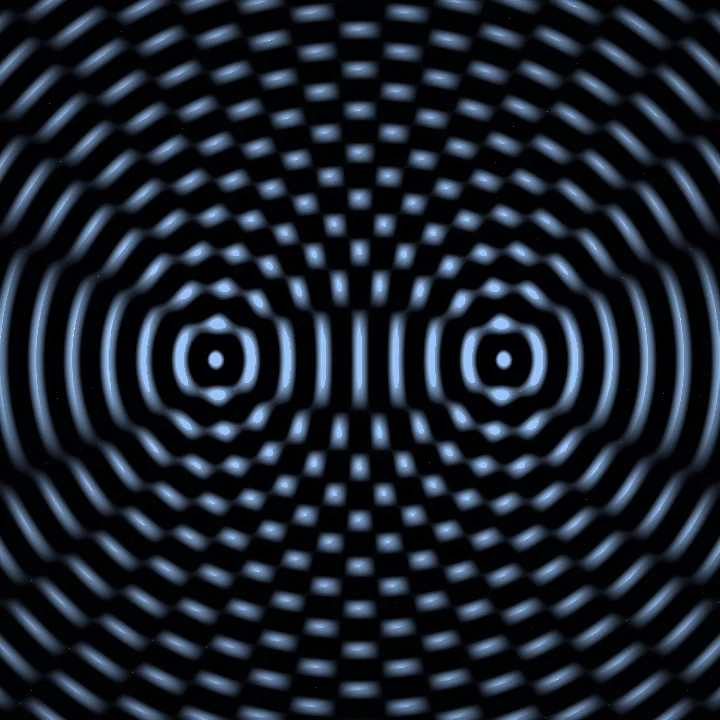
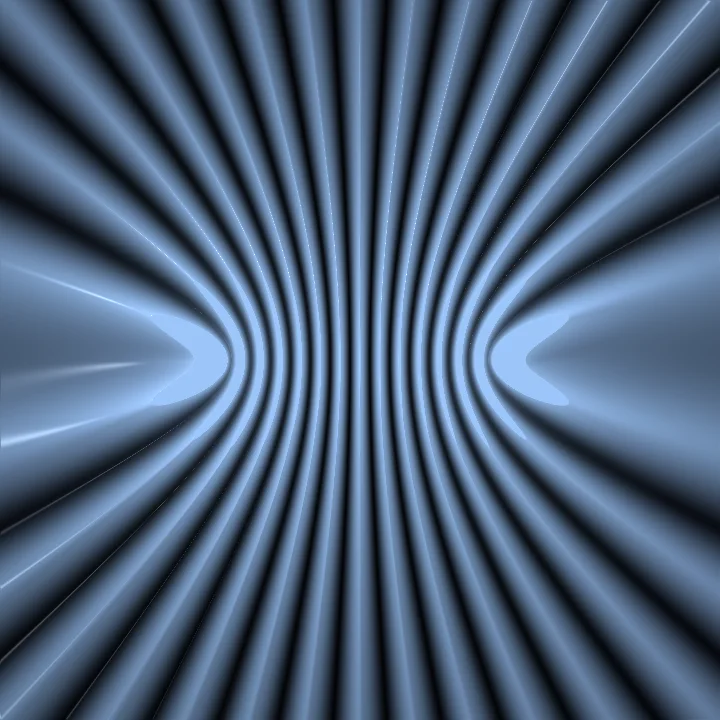
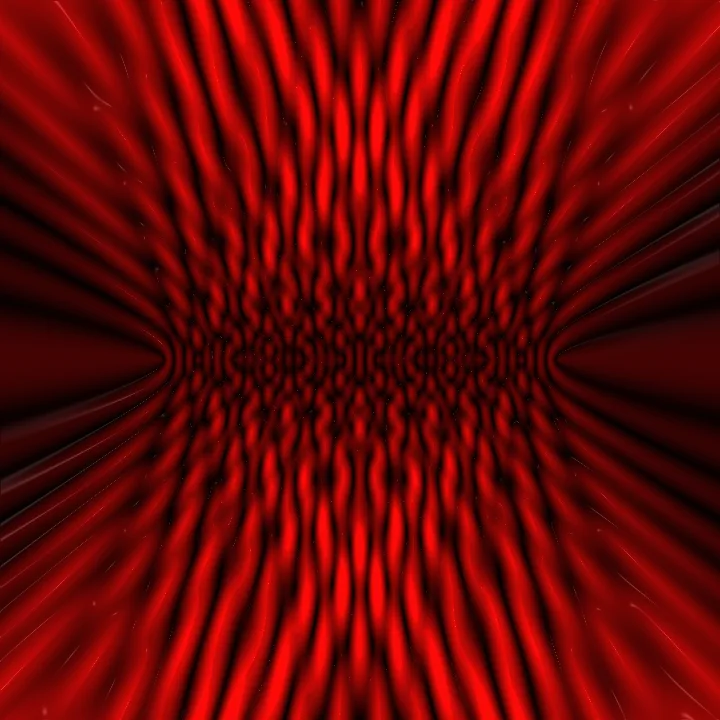
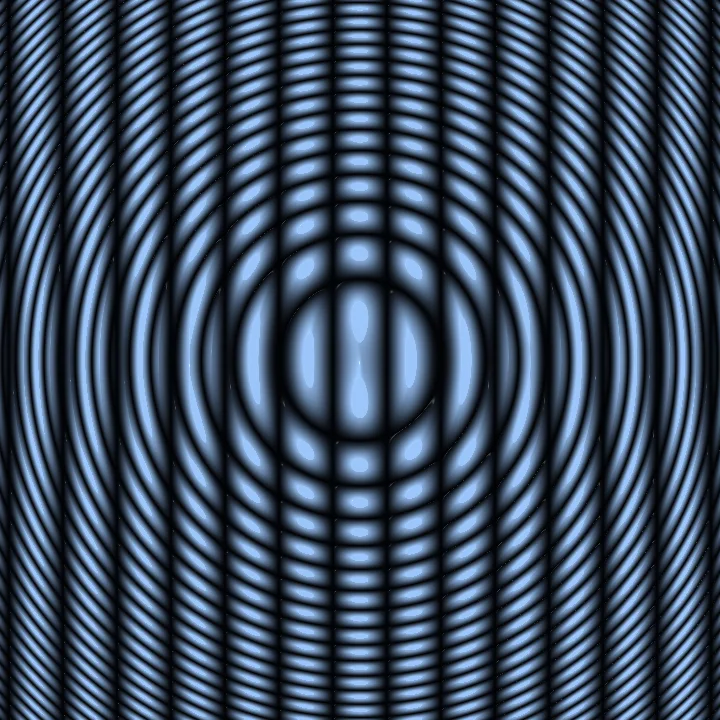
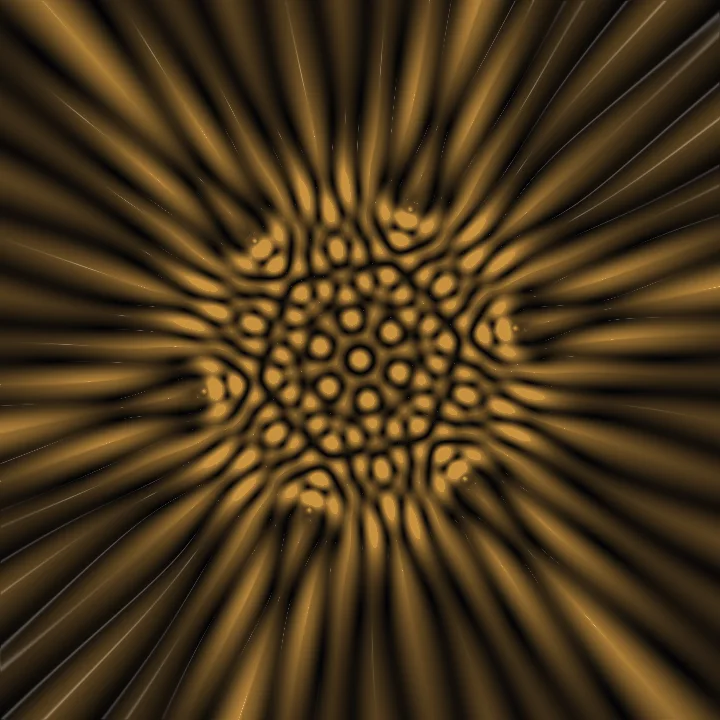
A model-driven visual study of superposed coherent waves.
TWO-SOURCE FIELD — Re ψλ 0.05 · p 0.35 · ripple tank
WHAT IS THIS
When two or more waves overlap, they add. Where two crests meet, the wave grows; where a crest meets a trough, it vanishes. This principle of superposition draws interference fringes between a few sources, diffraction patterns behind a row of slits, and moiré where two periodic patterns cross.
This study sums coherent point sources analytically. From the complex field ψ(x,t) it shows both the moving wavefronts, Re ψ, and the time-averaged intensity, ½|ψ|² — the fringe pattern a long exposure would record. It runs in real time on the GPU (GLSL).
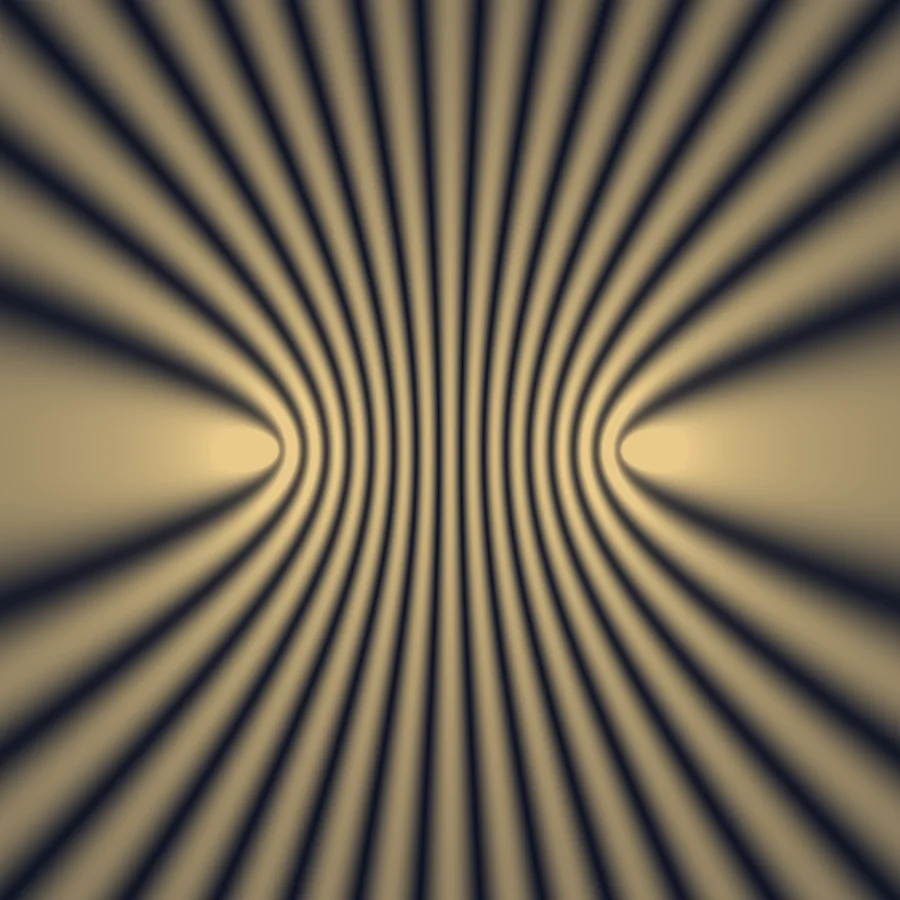
two-source fringes — the time-averaged photographsources · N 2 · λ 0.055 · intensity ½|ψ|²
Motifinterference / diffraction / moiré
MethodA small simulator was generated and modified with AI assistance, then ported to a real-time GPU (GLSL) renderer — an analytic superposition of coherent point sources, shown as moving wavefronts and as time-averaged fringes. The visual output was selected through curated parameter exploration.
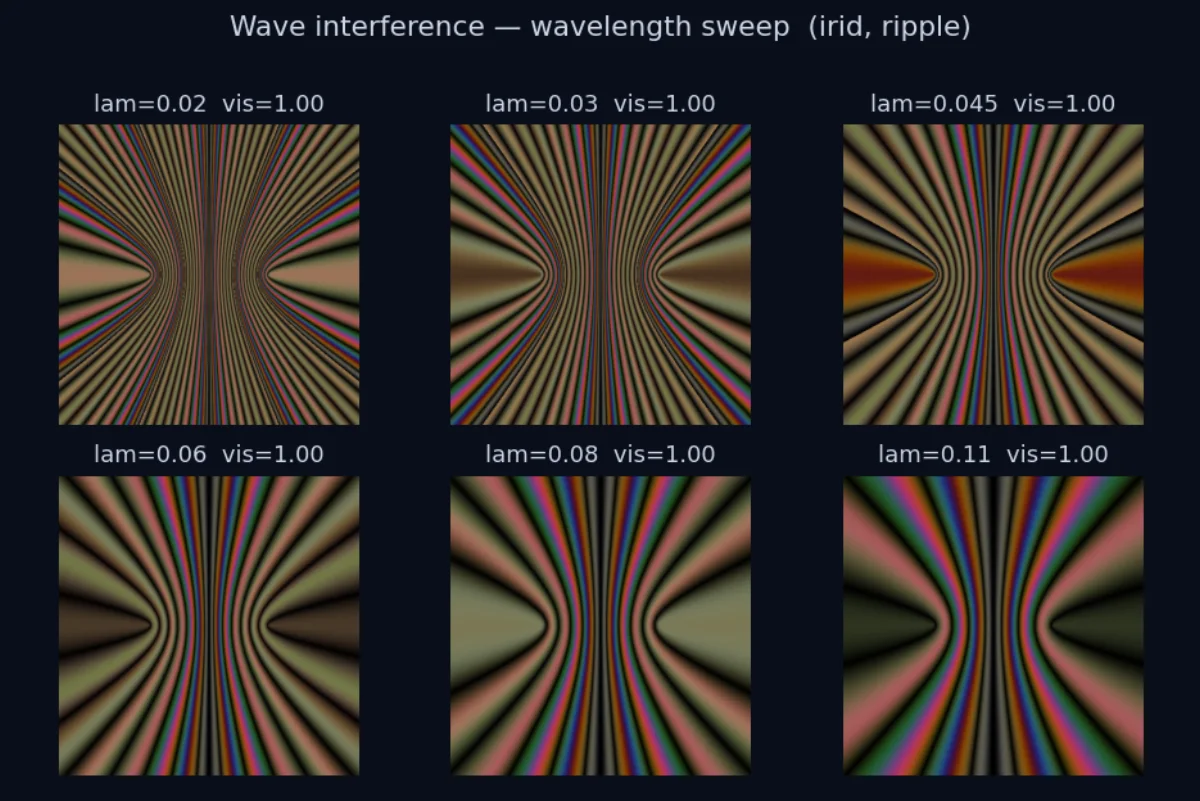
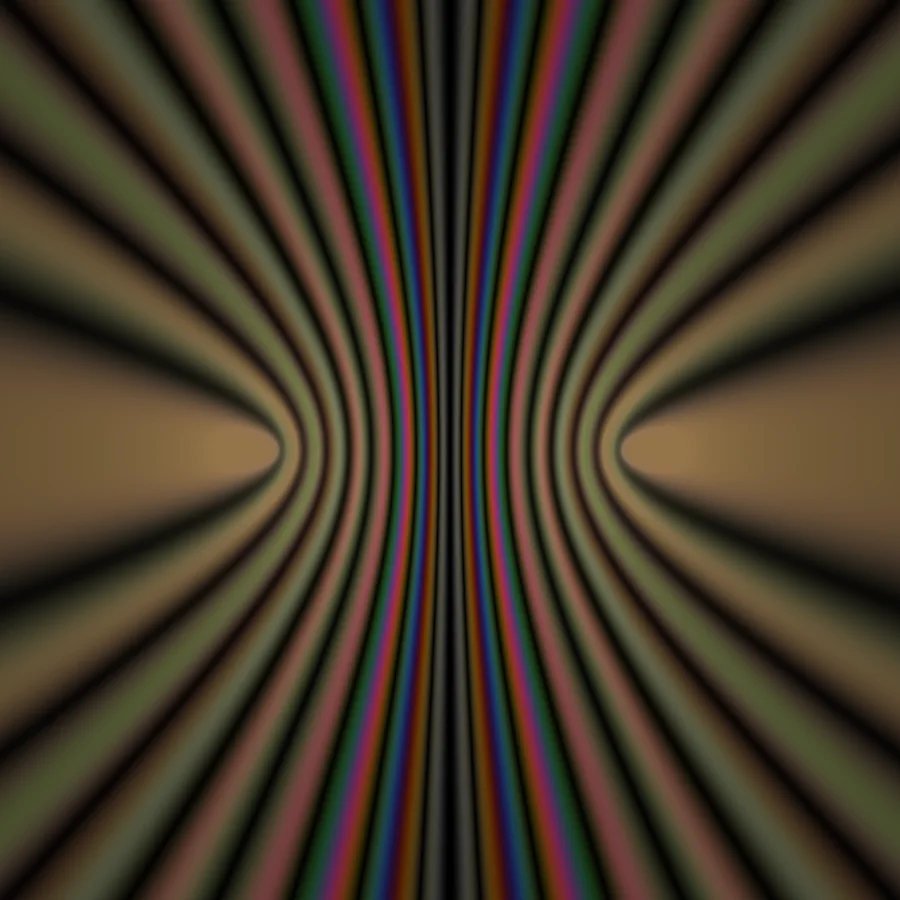
ObservationA monochromatic pair draws the classic hyperbolic fringes; adding sources builds rosettes, a line of them becomes a diffraction grating, two crossed gratings a moiré. In white light each fringe takes the colour of its path difference — the interference turns iridescent.
ReferenceThomas Young, "The Bakerian Lecture. Experiments and Calculations Relative to Physical Optics," Philosophical Transactions of the Royal Society of London, vol.94, 1-16 (1804).
This is not a scientific simulation result, but a visual interpretation of the phenomenon.
PARAMETERS EXPLORED
parammeaningeffect on the image
λ (wavelength)the wavelengthsmaller means finer fringes — the fringe spacing is proportional to λ
N (sources / slits)number of sources or slits2 is the classic two-source pair; more builds a rosette, then a diffraction grating whose principal maxima sharpen
geometrythe arrangement of the sourcesa ring gives interference, a line gives diffraction, two crossed gratings give moiré
p (amplitude decay)how the amplitude falls with distance0 is an ideal plane wave (clean fringes); 0.5 a cylindrical wave; 1 the shading of a spherical wave
displaywhat is shown from the same fieldthe moving wavefronts Re ψ, or the still fringe photograph ½|ψ|²
colourthe light sourcea single-wavelength laser, or the thin-film iridescence of the optical path difference
Each image below records its exact parameter set.
THE MATHEMATICSthe model behind the images
No wave equation is solved — the field is an analytic superposition of coherent point sources, evaluated directly. The same complex field gives both the moving wavefronts and the still fringes.
A monochromatic laser gives single-hue fringes — one wavelength, one colour. White light does not: the optical path difference Δ between two routes, measured in wavelengths, decides which colour interferes constructively, so the fringes turn iridescent.
This is thin-film interference — the colour of a soap bubble, an oil slick, a CD, a beetle's shell. The iridescent mode colours each fringe by frac(Δ/λ) through the Newton thin-film series.
These are artistic approximations of the physics (633 nm / 514 nm are representative laser lines; the hue mapping is a visual interpretation), not measurements.
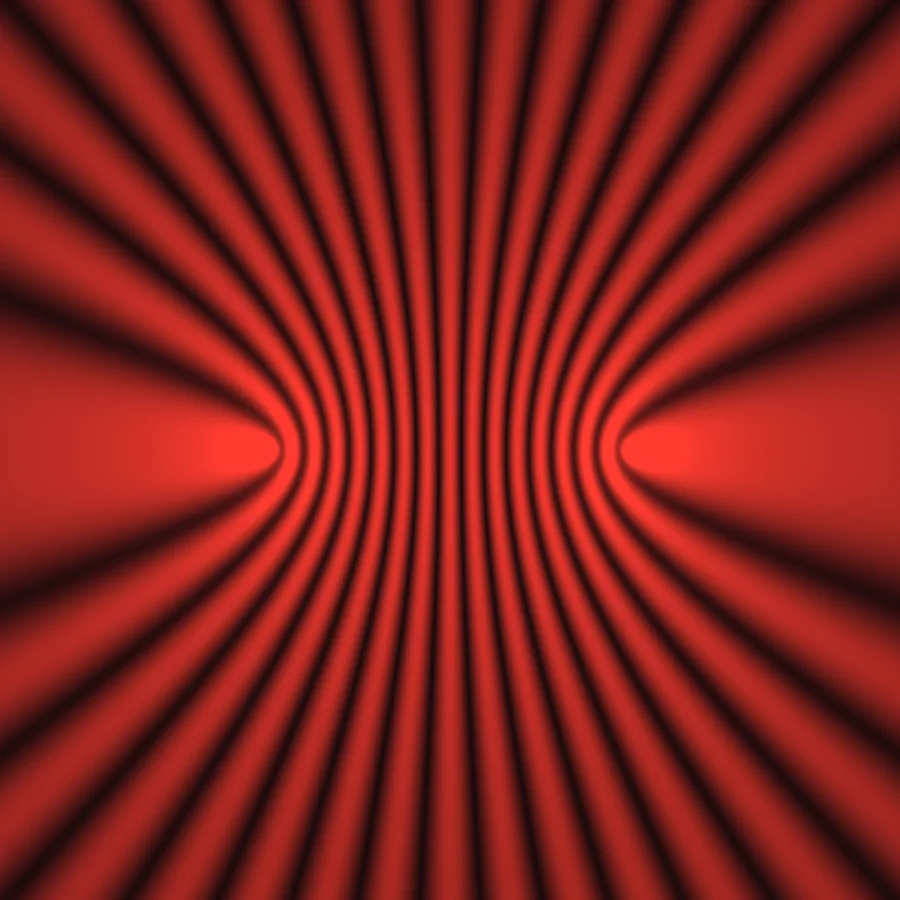
He–Ne laser633 nm · single red
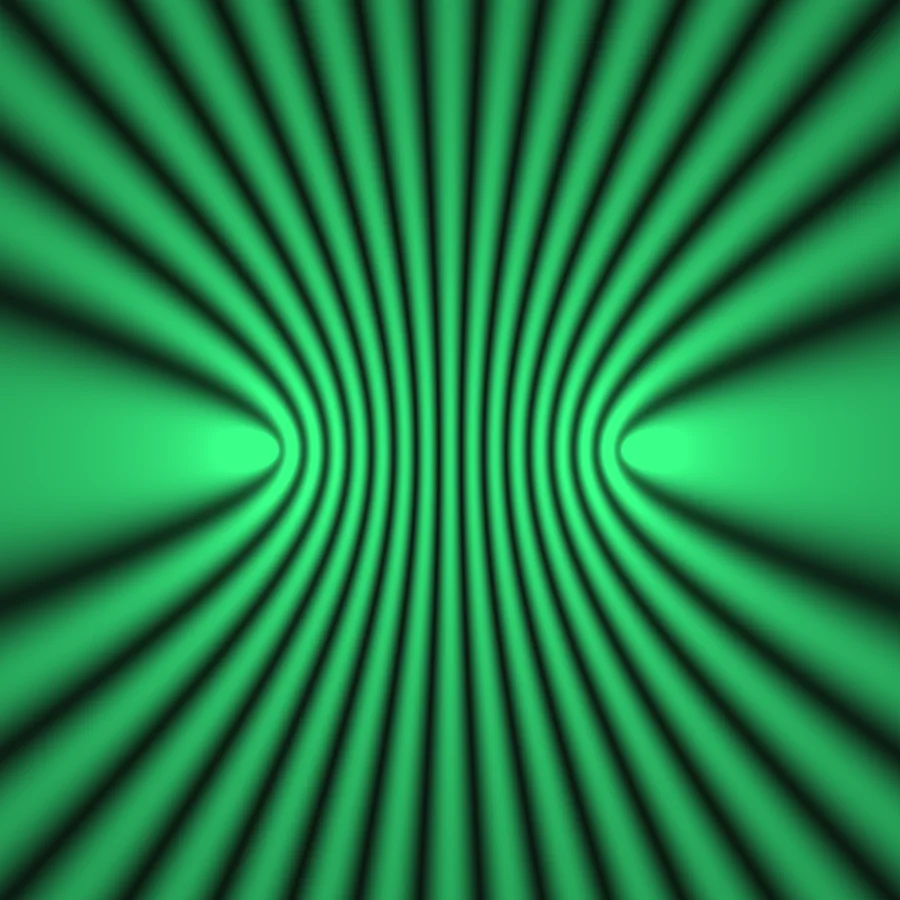
Argon laser514 nm · single green
White lightbroadband · iridescent
Weaver cuthouse palette · teal / gold
The same two-source pattern under four light sources — mono laser lines, broadband white, and the house cut.
REFERENCES
Thomas Young. "The Bakerian Lecture. Experiments and Calculations Relative to Physical Optics." Philosophical Transactions of the Royal Society of London, vol.94, 1-16 (1804).
Isaac Newton. "Opticks: or, A Treatise of the Reflexions, Refractions, Inflexions and Colours of Light." London (1704).
INTERACTIVE STUDY
The same analytic superposition runs live in your browser — coherent point sources summed in real time. It is a deliberately simplified instrument, capped in resolution with a few curated knobs and no export, separate from the full engine used to author the finished works. Toggle between the moving wavefield and the time-averaged fringes, and let white light turn them iridescent.
SIMPLIFIED INSTRUMENTSUPERPOSITION — COHERENT SOURCES · LIVE
This interactive study is not intended as a scientifically validated reproduction. It is a visual interpretation generated from an implemented model and curated parameter exploration — and it is a deliberately simplified instrument, separate from the full engine used to author the finished works.