Temperature is the invisible conductor of the BZ reaction. A chemical reaction's rate follows the Arrhenius law — warm faster, cold slower — so in a dish that is not the same temperature everywhere, the oscillation runs at different speeds in different places. You never see the temperature itself; you only see what it does to the waves: their wavelength, the bending of their fronts, where their sources gather.
This study takes #01's Oregonator reaction–diffusion system and multiplies its reaction rate by a prescribed temperature field. Where a region's stoichiometry is also made temperature-dependent, its whole pattern regime shifts — so a single canvas can hold turbulence and calm at once. The temperature field is treated as a frozen landscape given from outside; the reaction runs on top of it.
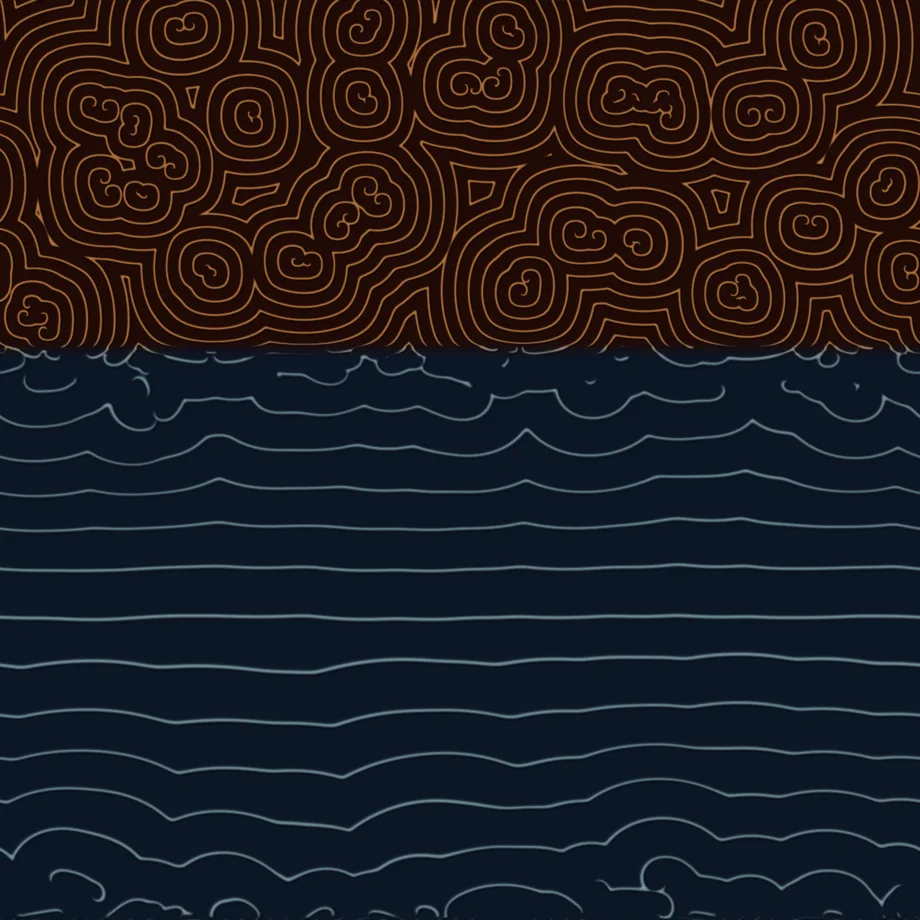
sky over sea — step temperature seamstep · horizon 0.62 · Ea 4 · Ea_f −2
MotifBZ reaction / Oregonator with a temperature field / phase & wave-speed gradients
MethodThe study #01 GPU (GLSL) reaction–diffusion engine was extended with an Arrhenius temperature field that modulates the local reaction rate — and, where a region's stoichiometry is temperature-dependent, its pattern regime. Built and modified with AI assistance; the geographies and the look were chosen through parameter exploration. The moving pieces animate the temperature field itself while the waves keep running.
ObservationOne medium reads as many worlds — a churning warm sky over a calm cold sea, chirped targets, pacemaker spots, organic geographies. Hotter means a faster clock, a shorter wavelength, and a thinner, sharper line. Colour follows temperature, not a catalyst.
ReferenceS. Arrhenius, "Über die Reactionsgeschwindigkeit bei der Inversion von Rohrzucker durch Säuren," Zeitschrift für Physikalische Chemie, vol.4, 226-248 (1889); J. J. Tyson & P. C. Fife, The Journal of Chemical Physics, vol.73, 2224-2237 (1980).
This is not a scientific simulation result, but a visual interpretation of the phenomenon.
WHAT CHANGED FROM #01
A deliberately different picture.
Study #01 — BZStudy #04 — Thermal
Colourfrom the catalyst’s oxidation state — navy to goldfrom temperature — ice-blue to ember-orange
Compositionone allover texture, edge to edgea geography inside the frame — with negative space where heat stills the reaction
Motionthe waves propagatethe field itself drifts, and the waves reorganise beneath it
PARAMETERS EXPLORED
parammeaningeffect on the image
tfieldtemperature-field shapestep: a sky/sea two-phase world · radial: rings tightening toward the warm centre · spots: pacemakers · blobs: organic thermal geography · gradient: a wavelength chirp
EaArrhenius sensitivity of the clocklarger values widen the hot⇄cold speed difference — a stronger wavelength gradient
Ea_ftemperature-dependent stoichiometrypushed negative, hot regions turn turbulent while cold regions go still — the main lever behind the sky/sea density contrast
T_lo / T_hitemperature rangethe range of speeds inside one field — the pressure range of the pen
horizon / seamstep position & boundary widththe sky-to-sea ratio, and how hard the coastline is
morphanimating the temperature fieldthe landscape drifts and the waves re-solve around it — the core of the moving pieces
Each image below records its exact parameter set.
THE MATHEMATICSthe model behind the images
Study #01’s Oregonator, with every reaction term multiplied by an Arrhenius rate field φ(x,y) — the invisible temperature that speeds or slows the local chemical clock.
∂t∂u=φ(x,y)ε1[u(1−u)−fvu+qu−q]+Du∇2u
The fast variable, its clock scaled by φ.
∂t∂v=φ(x,y)(u−v)+Dv∇2v
The slow variable, scaled by the same φ — the nullclines are unchanged; only the local time-scale moves.
φ(x,y)=exp[Ea(T01−T(x,y)1)]
The Arrhenius field. Hotter means a faster clock, a shorter wavelength, and thinner sharper lines; letting f and q depend on T lets one canvas hold turbulence and calm at once.
Inspired by the Oregonator with an Arrhenius-type temperature field. E_a is a model knob, not a measured activation energy.
SELECTED STILLS — 5
sky over seastep · horizon 0.62 · Ea 4 · Ea_f −2
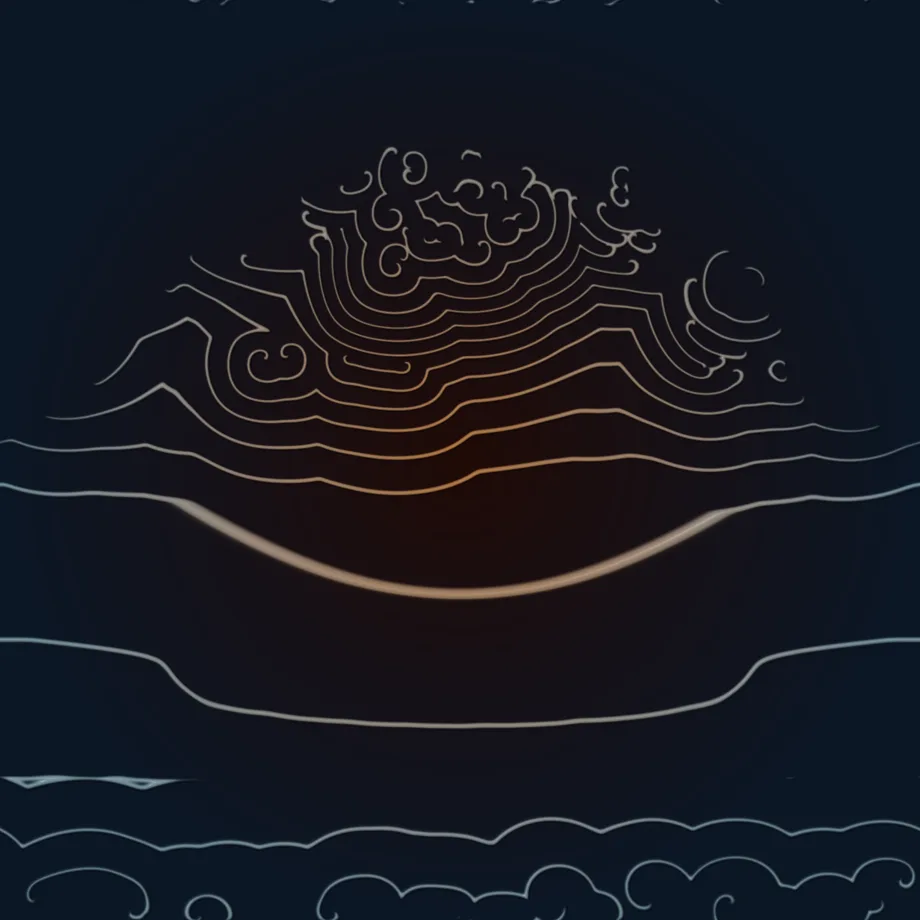
high horizon — a wide swelling seastep · horizon 0.76 · Ea 4 · Ea_f −2
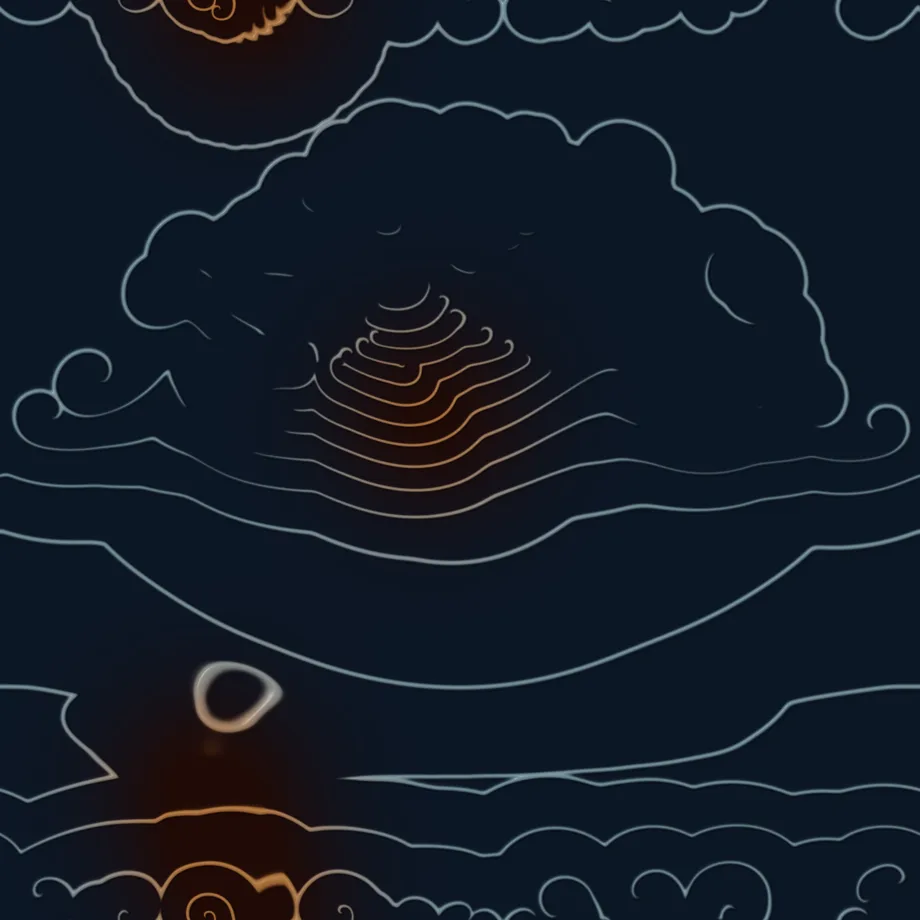
chirped target risingradial · Ea 4 · Ea_f −2
pacemaker ringsspots · Ea 4 · Ea_f −2
organic thermal geographyblobs · Ea 4 · Ea_f −2
COLOUR = TEMPERATURE
Study #01 coloured the field by the catalyst's oxidation state. This study changes the logic: here hue comes from the invisible temperature. A cold steel-blue ice and a hot ember orange sit at the two ends of the field.
The wave amplitude sets the luminance, and the crest lifts toward white-hot. So the thermal geography reads as colour while the chemistry reads as light — which is what lets the same medium look like a warm sky over a cold sea.
The palette is an artistic mapping of an abstract temperature, not a measured colour.
S. Arrhenius. "Über die Reactionsgeschwindigkeit bei der Inversion von Rohrzucker durch Säuren." Zeitschrift für Physikalische Chemie, vol.4, 226-248 (1889).
J. J. Tyson, P. C. Fife. "Target patterns in a realistic model of the Belousov-Zhabotinskii reaction." The Journal of Chemical Physics, vol.73, 2224-2237 (1980).
R. Luther. "Räumliche Fortpflanzung chemischer Reactionen." Zeitschrift für Elektrochemie, vol.12, 596-600 (1906).
INTERACTIVE STUDY
A small window into the model behind this study — a deliberately simplified instrument, reduced in resolution, scope, and rendering. The finished works above are something else entirely: parameters swept, frames chosen, and graded by hand from the full engine. Slide the horizon and the heat, and watch one chemistry split into two worlds.
SIMPLIFIED INSTRUMENTOREGONATOR × ARRHENIUS · LIVELENS — TEMPERATURE FIELD
This interactive study is not intended as a scientifically validated reproduction. It is a visual interpretation generated from an implemented model and curated parameter exploration — and it is a deliberately simplified instrument, separate from the full engine used to author the finished works.